
Can One Filling Machine Handle Liquids With Different Viscosities?
Can One Filling Machine Handle Liquids With Different Viscosities?
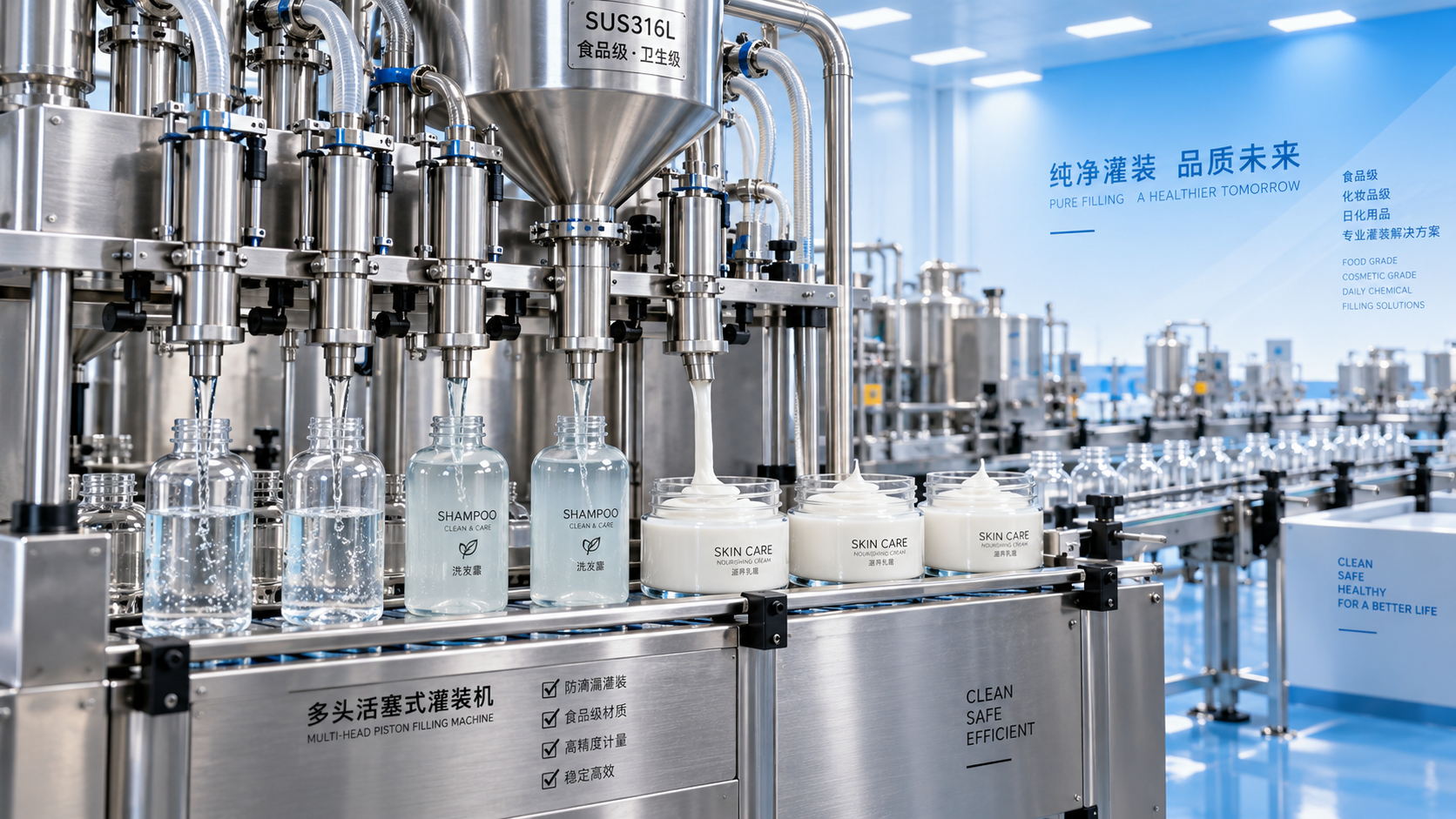
Can one filling machine handle liquids with different viscosities? In some cases, yes. In others, trying to make one machine fill everything from water-thin liquid to heavy cream becomes an expensive compromise. The real answer is not determined by viscosity alone. It depends on how the product flows, whether it contains particles or foam, the required fill accuracy, container format, sanitation requirements, and how often the line changes products.
A beverage producer may want to fill juice, syrup, and a thicker fruit concentrate on the same line. A daily-care plant may run hand soap in the morning and lotion or shampoo later in the day. Chemical packers often deal with solvents, detergents, lubricants, and viscous additives. These are all reasonable applications for flexible equipment—but only when the filling method is selected around the hardest product, not the easiest one.
The common mistake is assuming that an adjustable speed setting makes a filler universal. It does not. Reducing or increasing speed can help, but it cannot turn a filling valve designed for free-flowing liquid into a reliable system for paste-like material. A flexible filling line needs the right pump, product path, nozzle arrangement, controls, and cleaning approach.
Viscosity Matters, but Flow Behavior Matters More
Viscosity is usually the first specification discussed because it is easy to understand: thin liquids flow quickly, thick liquids resist movement. But production behavior is more complicated. Some products become thinner when warmed or agitated. Some creams settle after standing in a hopper. Some sauces have a smooth base but include herbs, seeds, or soft particles. Others trap air and foam heavily once they are pumped.
This is why a supplier should ask for more than a product name. “Detergent,” “sauce,” or “cosmetic lotion” does not tell an engineer enough. A dishwashing liquid may be relatively easy to transfer but foam badly. A conditioner may have a similar apparent thickness to a lotion, yet its stringy texture can leave tails at the nozzle. A chemical product may be thin but still require special seals, explosion-control measures, or corrosion-resistant contact parts.
Temperature also changes the decision. Products filled hot, products stored in a cold room, and products transferred after mixing can behave very differently. A line that performs well during a supplier trial using freshly prepared, warm material may struggle when the same product arrives colder and has sat in the balance tank for an hour.
Which Filling Principles Offer the Most Flexibility?
No filling technology is best for every liquid. The sensible comparison is between the product range you actually plan to run and the operational compromises each technology introduces.
For a facility filling a genuinely mixed product portfolio, piston systems and certain positive-displacement pump systems are often the more adaptable starting point. They can move products that gravity fillers cannot handle well, and they can usually be configured with anti-drip nozzles, bottom-up filling, hopper agitation, heated product paths, or larger passages where needed.
That said, “more adaptable” is not the same as “fit for every product.” A machine optimized for thick mayonnaise-like material may technically fill a thin solvent, but the production team may face excessive dripping, splashing, or unstable fill performance. Conversely, a fast multi-head liquid filler may run a medium-viscosity shower gel, yet become slow and inconsistent with a dense cream.
The Pump Is Only One Part of the Decision
When people ask whether one filling machine can handle different viscosities, they often focus entirely on the pump. In practice, the surrounding hardware frequently decides whether the line is pleasant to operate or constantly troublesome.
Start with the product supply system. Thin liquids may feed consistently from a simple tank, but thick products can bridge, settle, or fail to replenish the pump chamber fast enough. A properly sized hopper, suitable inlet diameter, gentle agitation, or a follower-plate arrangement may be required. For products that are sensitive to shear, aggressive mixing can be as problematic as insufficient mixing. The material may lose texture, incorporate air, or separate.
Nozzles deserve equal attention. Shut-off nozzles reduce drips, but their design needs to match the product. Bottom-up nozzles can help with foaming liquids and improve the presentation of thick products by reducing trapped air. For stringy gels or sticky creams, nozzle lift timing and cut-off action can matter more than a small increase in nominal filling speed.
Container shape changes the equation too. A wide-mouth jar is forgiving. A narrow-neck bottle holding viscous lotion is not. The machine needs enough time for the product to enter without backing up around the neck, while the conveyor and bottle-handling components must keep containers stable. If a line fills several bottle families, change parts and guide adjustments should be considered early, not added as an afterthought.
Accuracy Across Different Products: What Changes in Real Production?
A filling machine may be repeatable with one product and less repeatable with another, even when the programmed volume is unchanged. That is not necessarily a machine defect. Viscosity changes resistance in the product path. Air pockets alter how material compresses and flows. A pump or piston may respond differently after a long pause than during continuous operation. Product temperature can shift throughout the shift.
For this reason, serious line planning should include trials with representative samples—not merely water. Ideally, testing covers the thinnest and thickest products, the smallest and largest planned fill volumes, and the most difficult container opening. It should also include normal production interruptions. A filler that looks accurate during a short uninterrupted run may reveal issues after nozzle cleaning, hopper replenishment, or a restart.
Weight checks remain essential, especially during changeover and early production. Automation can stabilize dosing, but it does not remove the need for process verification. In regulated pharmaceutical applications and in food or chemical operations with defined tolerances, the acceptable control method must be determined against the product, local requirements, and the producer’s own quality procedures.
A Flexible Machine Can Create a Slow Changeover Problem
The attraction of one versatile machine is obvious: lower capital outlay, less floor space, and fewer assets to maintain. It is especially appealing to small businesses, contract packers, and producers with seasonal product mixes. But flexibility has a cost when products are far apart in viscosity, color, fragrance, or hygiene risk.
A line moving from clear beverage syrup to dark sauce, or from fragranced body wash to unscented lotion, may require substantial cleaning and inspection. Product-contact components must be accessible. Dead legs in piping should be minimized. Seals, hoses, valves, and nozzles need to be compatible with both the product and the cleaning method. If cleaning consumes more time than filling, the “one machine for all products” strategy may not be economical.
The practical question is not just, “Can the machine fill it?” Ask, “Can our team change it over, clean it, verify it, and return it to stable production in a reasonable time?” For a plant with frequent short batches, quick-release parts, recipe storage, repeatable guide settings, and clear cleaning access can be more valuable than a higher maximum output figure.
When Separate Filling Systems Make Better Business Sense
There is a point where a universal filler stops being a flexible solution and starts being a bottleneck. Separate systems are worth considering when the product range includes extremely thin liquids and dense pastes, when one group requires hot filling and another does not, or when sanitation and cross-contamination controls differ sharply between products.
Dedicated equipment may also be justified when a high-volume product dominates the schedule. It is rarely sensible to slow a profitable, high-throughput liquid line because the same machine must occasionally be reconfigured for a thick cream. A smaller semi-automatic or lower-speed piston filler can sometimes handle specialty batches more efficiently than forcing every SKU through the main automatic line.
This does not always mean buying two complete production lines. A modular approach can work: one container preparation and conveying section, paired with different filling modules or dedicated product-feed assemblies. Supporting equipment also matters here. Bottle washing and rinsing machines, capping or corking machines, shrink and drying equipment, filtration units, carton sealing systems, and conveyors should be planned as a connected process rather than selected in isolation.
How to Specify a Multi-Viscosity Filling Project
Before selecting equipment, prepare a product-and-package matrix. It does not need to be complicated, but it should be honest about what will run on the line. Include each product’s approximate handling condition, expected temperature at filling, particle content, foaming tendency, container type, fill volume, closure, and planned batch frequency. Flag the products that are difficult to clean, sensitive to shear, flammable, corrosive, or especially prone to dripping.
Then identify the true priority. Is the goal maximum speed for one core product? Is it the widest possible SKU range? Is it a compact line for a growing small business? Is it reliable hygiene for food, pharmaceutical, daily chemical, or chemical production? Different priorities lead to different machine configurations, even when the same liquids are involved.
A capable equipment partner should be able to discuss filling technology alongside the rest of the line: rinsing, conveying, capping, drying, labeling or secondary packaging interfaces, and filtration where required. OEM and tailored filling-line projects are most successful when these interfaces are settled before fabrication, not during installation.
The Short Answer: Yes, Within a Defined Operating Window
One filling machine can often handle liquids with different viscosities, particularly when the range is moderate and the system uses an adaptable piston or positive-displacement filling arrangement. But no machine should be described as universal without defining product behavior, fill volumes, container geometry, cleaning expectations, and required output.
The safest buying decision is to design around the most demanding product and verify performance with actual samples. If the thickest, foamiest, most temperature-sensitive, or hardest-to-clean SKU can be filled accurately without making routine changeovers painful, the rest of the product range is far more likely to run well. If it cannot, a modular line or a separate filler is usually the more practical choice.
Thank you very much for writing to us. Please leave your message and contact information, we will reply to you within 24 hours.