
How Do I Choose a Juice Filling Machine for a Small Business?
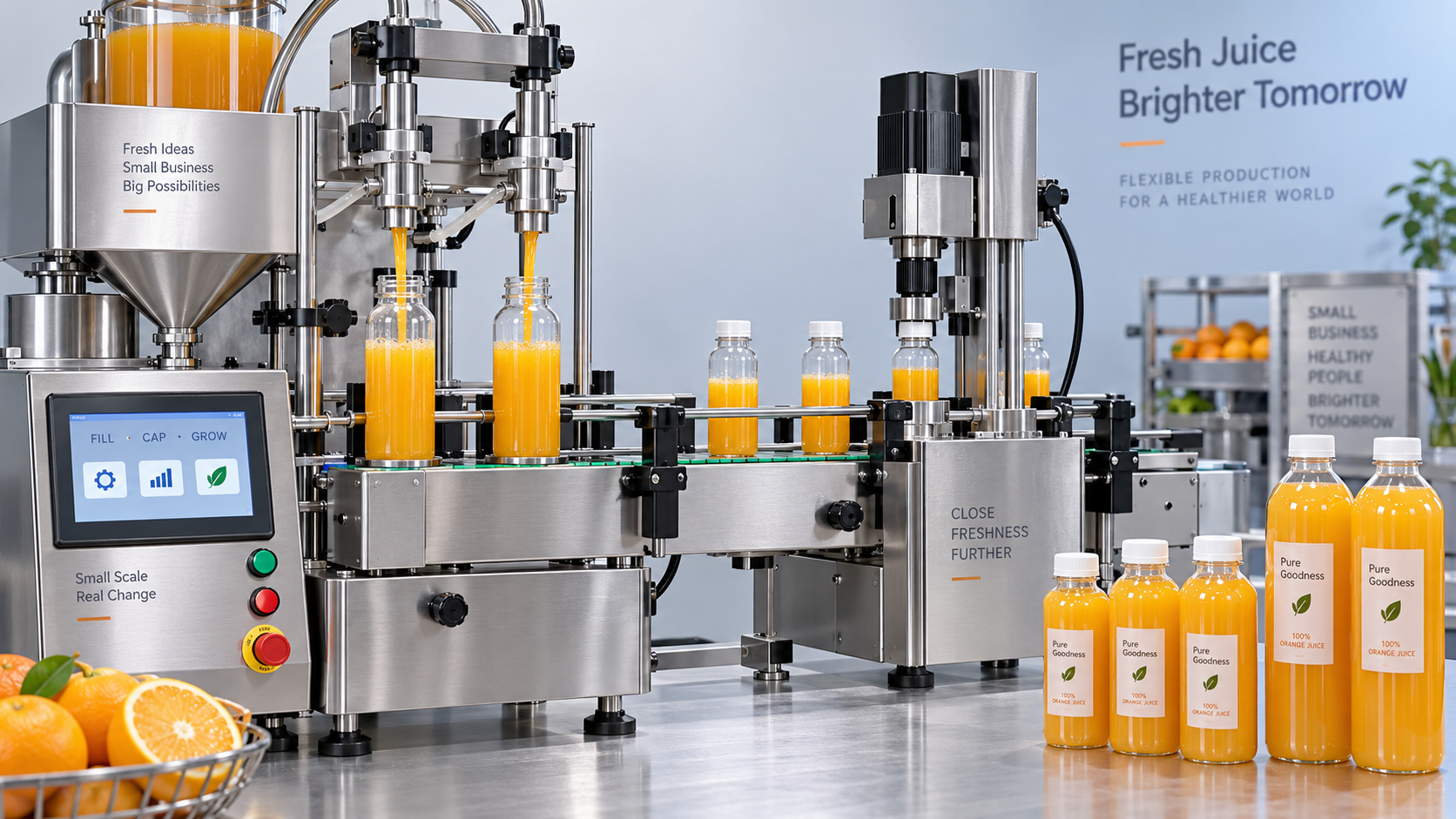
Choosing a small business juice filling machine means balancing production capacity, product quality, and budget—not simply buying the fastest equipment. A machine that handles clear apple juice comfortably may struggle with a thick mango blend. An affordable tabletop filler may suit your first production batches but leave your team waiting once orders increase.
The right choice starts with your juice, your packaging, and the way you actually work. Before comparing quotations, define what the machine must do on a normal production day, including cleaning, bottle changes, and interruptions. That gives you a more useful buying framework than headline speed alone.
Start with the juice, not the machine catalogue
“Juice” covers products with very different filling requirements. Thin, filtered drinks flow easily; pulp-rich blends can settle, clog narrow passages, or fill unevenly. Foamy products may need slower delivery or bottom-up filling. Temperature also changes flow behavior and affects seals, hoses, and packaging.
Prepare a short product profile for every drink you expect to bottle:
- Consistency: thin, moderately viscous, or thick, including variation between batches.
- Solids: whether pulp, fibers, seeds, or other particles are present, and their approximate size.
- Filling temperature: chilled, ambient, or hot, with the actual operating range.
- Foaming tendency: what happens when the juice is pumped or poured.
- Recipe sensitivities: ingredients that require careful handling, allergen controls, or compatible contact materials.
Do not describe a pulp-containing drink simply as “liquid.” Ask the supplier to confirm the usable passage size through valves, pumps, and nozzles. A wide nozzle alone does not solve a restriction elsewhere in the product path.
If solids settle quickly, the feed tank may need gentle agitation. This should maintain a consistent blend without unnecessarily introducing air or damaging the product. The best answer is a trial with your juice, not an assumption based on a similar-looking beverage.
Calculate the output you need during the filling window
Small businesses often overestimate available production time. An eight-hour shift is rarely eight hours of filling: preparation, sanitation, recipe changes, packaging setup, breaks, and end-of-day cleaning all take time.
Consider a planning example. If you need 1,200 bottles per day and have four hours available for filling, your required average is 300 bottles per hour. The machine’s quoted speed should exceed that average sufficiently to accommodate routine interruptions, but the necessary margin depends on your operation. This is a calculation method, not a recommended machine specification.
Ask suppliers to distinguish maximum mechanical speed from expected sustained output with your juice and bottle. Nozzle count does not tell the whole story. Filling volume, foaming, bottle loading, cap placement, and operator workflow all affect production.
Also calculate liters per hour. A machine producing small bottles quickly may not achieve the same bottle count with a one-liter container. Give suppliers your current sales mix and a realistic growth scenario so they can assess both.
Which filling technology fits your product?
Several filling methods can work for juice. None is universally best, and machine design matters as much as the technology label.
For clear juice, gravity or an appropriate metered system may offer a straightforward solution. For a thicker blend, a piston or suitable pump system may be more practical. These are starting points, not final selections.
One distinction deserves attention: equal fill height is not necessarily equal fill volume. Bottles can vary internally. If you sell by declared volume, ask how the system controls and verifies quantity within applicable requirements rather than judging performance only by shelf appearance.
Match the filler to your preservation process
A filling machine does not, by itself, make juice shelf-stable. Refrigerated fresh juice, hot-filled beverages, and aseptically packaged products involve different processing and hygiene requirements.
For refrigerated juice, the filling arrangement must support hygienic handling and your validated cold-chain and shelf-life controls. For hot filling, check the temperature rating of all product-contact components, bottle heat resistance, closure suitability, and any required holding, cooling, or container-treatment steps.
Aseptic production requires a coordinated, validated system for product treatment, packaging sterilization, and the filling environment. It is not simply an ordinary automatic filler operating in a clean room.
Confirm your preservation approach with a qualified food-processing or food-safety specialist before ordering equipment. Then provide the resulting process requirements to the supplier. This avoids buying a mechanically capable machine that does not fit the safety requirements of your product.
How much automation will genuinely help?
Automation should remove your actual bottleneck. It should not add complexity your team cannot comfortably manage.
Semi-automatic filling: useful when flexibility matters
A semi-automatic juice filler can suit modest batch sizes, frequent recipe changes, and businesses still testing packaging formats. Operators typically position bottles and initiate filling, while the machine controls dispensing.
Evaluate the complete task, including moving filled bottles and applying caps. Labor savings may be limited if operators spend most of their time handling containers. Check ergonomics, drip collection, bottle support, and whether one person can work at a steady pace without rushed movements.
Automatic filling: valuable when bottle handling limits output
An automatic inline filler becomes more attractive when demand is steady and manual bottle positioning restricts production. Conveyors, bottle sensors, and coordinated filling can reduce repetitive handling, provided upstream and downstream equipment keep pace.
For many growing businesses, a modular line is a sensible middle ground: automate filling and capping now, then add further packaging equipment as justified. Ask whether future expansion is genuinely supported through compatible controls, conveyor heights, and usable floor space.
Look beyond the filler: the line must work as one system
A good small business juice filling machine can still underperform when connected to mismatched equipment. Bottle preparation, closure application, and packing deserve attention before purchase.
- Washing or rinsing: choose a method appropriate to the container supply and validated sanitation process. New and returnable bottles may need different treatment.
- Capping or corking: match the equipment to the closure geometry and sealing requirements. Check torque control for screw caps.
- Conveying: verify stability with empty and filled bottles, especially tall, lightweight, or unusual containers.
- Drying and shrinking: consider whether wet bottle surfaces need drying before labeling, or whether shrink sleeves or tamper bands are required.
- Secondary packaging: carton sealing may become important once end-of-line handling absorbs too much labor.
Filtering equipment may also be relevant, but filtration must match the recipe. Removing solids to make filling easier can change the product customers expect. Select a filler suitable for your intended juice rather than altering the drink unnecessarily.
Request a line layout showing equipment dimensions, operator positions, cleaning access, utilities, and bottle accumulation areas. A compact footprint on a drawing is less useful if nobody can reach the machine for maintenance.
Cleaning requirements can outweigh a lower purchase price
For a small team, cleaning is both a food-safety responsibility and a major use of production time. Ask the supplier to explain the cleaning procedure step by step, including what must be dismantled and what can be cleaned in place.
Stainless steel construction alone does not prove hygienic design. Product-contact materials, seals, surface condition, connections, drainage, and inaccessible pockets all matter. Confirm compatibility with the juice and the cleaning chemicals and temperatures you intend to use.
If a machine is described as clean-in-place compatible, ask which circuits are included and what supporting equipment is required. Effective cleaning still depends on defined procedures and verification; the presence of a cleaning connection is not enough.
For businesses making several recipes, assess changeovers too. How much juice remains in the system? How easily can you prevent flavor carryover or manage allergens? A filler that drains well and is straightforward to inspect can be more valuable than one with a slightly higher advertised speed.
Compare the cost of ownership, not just the quotation
Two quotations are only comparable when they cover the same scope. One may include a product tank, transfer pump, conveyor, and installation support; another may cover only the filling unit.
Build a cost comparison that includes:
- Equipment, bottle-format parts, and optional accessories.
- Shipping, applicable duties, installation, and commissioning.
- Compressed air, electrical supply, drainage, and other site modifications.
- Operator training, cleaning labor, and routine maintenance.
- Consumables, spare seals, replacement components, and product losses.
Request prices and lead times for commonly replaced parts before ordering. An inexpensive machine is less attractive if a routine seal replacement causes a long interruption. Clear documentation and accessible technical support are particularly important when your business has no dedicated maintenance engineer.
Use a product trial to make the final decision
A demonstration with water proves basic operation, not suitability for your juice. Wherever practical, arrange testing with representative product, bottles, and closures—including your most difficult recipe and packaging format.
Agree on acceptance criteria before the trial. These should cover sustained output, filling consistency, dripping, foam, pulp distribution, closure performance, and changeover time. Check performance after the machine has been running, not just during the first few bottles.
Ask to see startup, shutdown, cleaning, and restart. These less glamorous moments often reveal whether equipment will be comfortable to operate every day.
A supplier offering filling machines alongside rinsing, capping, conveying, drying, and carton-sealing equipment can help coordinate the line. Tailored configurations, OEM arrangements, or wholesale sourcing may support your purchasing plan, but clarify who is responsible for integration, documentation, testing, and after-sales support.
A practical buying brief keeps the decision focused
Before requesting your final proposal, send the supplier a concise brief containing your juice characteristics, preservation process, bottle and cap samples, filling volumes, daily output target, available filling hours, floor plan, utilities, and expected expansion.
The right choice is the smallest practical system that meets those requirements reliably, with room for credible growth. It should protect product quality, be manageable for your team to clean and maintain, and fit the rest of your packaging workflow. When those fundamentals are settled, speed and price become meaningful comparisons—not distractions from the equipment your business actually needs.
Thank you very much for writing to us. Please leave your message and contact information, we will reply to you within 24 hours.