
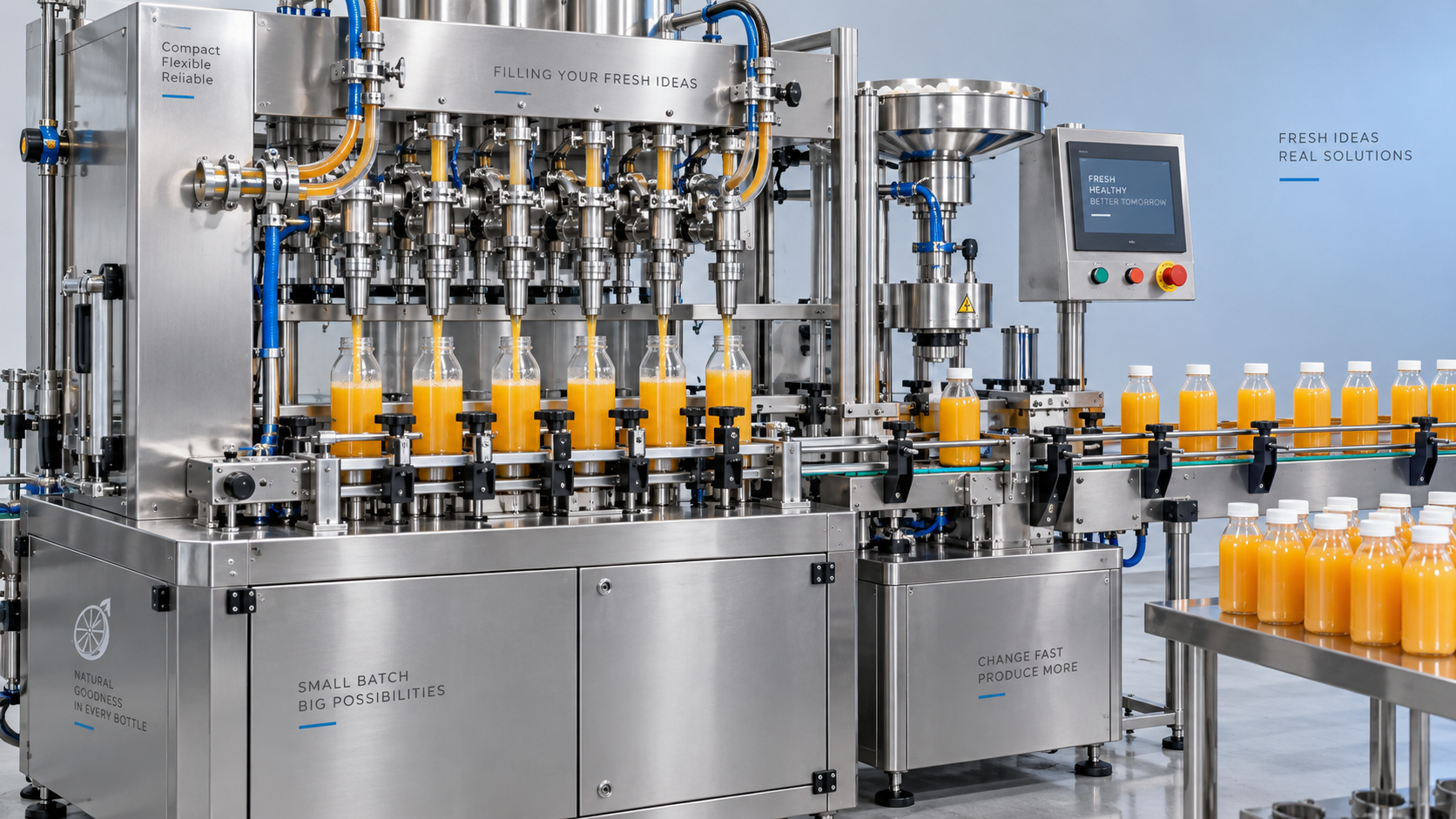
Is Automatic Juice Filling Worth It for Made-to-Order Batches?
Is an automatic juice filler worth buying for small batches? Often, yes—when recurring orders justify the investment and the machine handles changeovers efficiently.
For made-to-order juice producers, the answer depends on more than filling speed. Flavor changes, bottle sizes, cleaning requirements and uneven demand all affect returns.
A suitable automatic filling machine can improve consistency and reduce repetitive labor. However, oversized equipment may consume money, floor space and valuable production time.
The strongest buying decision starts with your actual order schedule, product characteristics and operating costs, then tests whether automation improves the complete production process.
When Does Automatic Filling Make Business Sense?
Small batches do not automatically rule out automation. A producer running several repeat orders every day may benefit more than one producing occasional large batches.
The important distinction is between batch size and recurring workload. Automation becomes attractive when enough similar orders accumulate to keep the equipment productively occupied.
Look for sustained filling overtime, inconsistent bottle volumes, operator fatigue or delayed dispatch. These indicate possible opportunities, although each problem needs a measurable baseline.
Automation is less compelling when recipes change constantly, production runs infrequently or manual filling already meets quality and delivery requirements with modest labor costs.
For very short runs, a compact semi-automatic filler may deliver better returns. It can improve dispensing accuracy while retaining flexibility for unusual bottles and recipes.
Buy the level of automation that removes your current constraint. Additional functions should earn their place through saved labor, improved control or reliable capacity.
Measure Your Real Workload Before Comparing Machines
Record several representative weeks of production, including quieter periods. Track bottles per order, orders per day, recipe changes, packaging formats and actual labor hours.
Separate filling time from setup, cleaning, product transfer, capping, labeling and packing. Otherwise, you may attribute every production delay to the filler itself incorrectly.
Also record how many people work simultaneously. Two operators spending three hours on a batch represent six labor hours, even when production finishes quickly.
Group orders by compatible recipe and bottle format where customer deadlines permit. Better scheduling may increase productive run time before any equipment investment occurs.
Identify the smallest normal batch and the largest realistic order. A suitable system should accommodate both without excessive product retention or unnecessary equipment adjustments.
Use this information to write a purchase requirement. State expected products, containers, daily output, available operating hours and the changeover time your business can tolerate.
Why Changeover and Cleaning Can Outweigh Filling Speed
Consider a 300-bottle order: a machine rated at 600 bottles per hour needs 30 minutes of filling time, assuming it achieves that speed consistently.
If setup and cleaning add another 60 minutes, the order occupies 90 minutes before allowing for other production tasks. Rated speed describes only part of performance.
A faster filler may barely reduce that total if preparation remains unchanged. For made-to-order production, reducing changeover time can therefore matter more than increasing speed.
Ask suppliers to demonstrate recipe changes, bottle adjustments, draining and cleaning. Include the time needed to restore settings and produce acceptable bottles after restarting.
Cleaning requirements depend on ingredients, processing conditions and your sanitation procedures. Pulp, sugars and shared equipment can complicate cleaning; allergen-containing recipes require appropriate controls.
Evaluate accessible product-contact surfaces, drainability and validated cleaning methods. Clean-in-place capability can help, but its effectiveness depends on equipment design and a suitable cleaning procedure.
Will the Filler Handle Your Juice and Bottles?
Clear juice, thick blends and products containing pulp behave differently during filling. Select the filling method through product trials rather than broad machine labels.
Depending on the application, gravity, pressure, piston or flowmeter systems may be suitable. No single filling technology is automatically best for every juice recipe.
Provide samples representing your most difficult products, including expected viscosity, pulp content, temperature and foaming behavior. Ask suppliers to explain any product-specific operating limits.
For suspended particles, confirm that valves and product passages accommodate their size. Also check whether the feed arrangement maintains acceptable product uniformity throughout each batch.
Bottle geometry matters as much as nominal volume. Narrow necks, lightweight containers and unstable bases may affect nozzle access, handling reliability and achievable production speed.
If you use hot filling, verify temperature compatibility across product-contact components, containers and closures. Filling equipment alone does not establish a validated preservation process.
Calculate Payback Using Net Savings, Not Brochure Capacity
Include the installed cost of the project: equipment, freight, commissioning, utilities, tooling, training and any necessary changes to your production area or supporting equipment.
Estimate annual benefits from labor genuinely saved, reduced giveaway and measurable avoided losses. Subtract added maintenance, utilities, cleaning materials and other recurring operating expenses.
For illustration, eight labor hours saved weekly across 48 production weeks, valued at $22 per hour, provide $8,448 in annual labor capacity or cost savings.
Add $700 of verified product savings and subtract $1,800 of added annual operating costs. Estimated net benefits become $7,348, before financing and tax effects.
A $22,000 installed investment would then have a simple payback of about three years. These figures illustrate the calculation; they are not equipment price benchmarks.
If cleaning reduces labor savings to three hours weekly, net benefits fall to $2,068 annually. The same purchase then takes approximately 10.6 years to repay.
Distinguish payroll reductions from redeployed staff time. Redeployment creates value when employees perform useful additional work, but it does not automatically reduce cash expenses.
Test a lower-demand scenario before committing. If the investment only works with optimistic sales growth, a smaller system or phased purchase may be more appropriate.
How Much Can Better Fill Consistency Actually Save?
Consistent filling can reduce unnecessary overfill while helping maintain declared quantities. The benefit depends on your current variation, target settings and applicable quantity-control requirements.
Measure existing performance across different recipes and operators. Record average filled quantity and variation using suitable calibrated equipment, then compare those results with supplier trials.
For example, reducing average giveaway by two milliliters across 115,200 bottles saves 230.4 liters annually. Value that product using a realistic, consistently applied cost basis.
At a product cost of $3 per liter, the saving is about $691 annually. Useful savings may still be too small to justify automation alone.
Ask how accuracy is specified: percentage of target, absolute volume or repeatability under defined conditions. Results may change with temperature, viscosity, foam and startup behavior.
Do not lower target fills solely because a machine appears precise. Establish settings that account for process variation, measurement uncertainty and the requirements governing your product.
Will Rinsing, Capping and Packing Keep Up?
A faster filler does little for dispatch capacity when operators cannot prepare bottles or apply caps quickly enough. Evaluate the entire sequence through finished packing.
Match filling output with bottle rinsing, capping and conveying capacity. Where relevant, include drying, shrinking, labeling and carton sealing in the same production assessment.
For small operations, automatic filling with manual bottle loading and separate capping may be practical. Confirm the staffing needed to sustain the proposed output.
Conveyors can reduce handling, but short runs require suitable guides, transfer points and accumulation space. Unstable bottles or excessive conveyor length can introduce additional interruptions.
Filtering equipment should follow product specifications. A filter selected without considering pulp requirements may remove desired solids or create unnecessary flow restrictions during production.
Request a layout showing operator positions, cleaning access and container movement. Confirm utilities, available floor space and how production continues when one station stops.
Choose the Smallest System That Meets Your Operating Needs
A tabletop or semi-automatic filler often suits variable orders where an operator can load containers economically. Its simpler setup may offset lower nominal output.
A compact automatic system becomes more attractive when repeated recipes, standard bottle formats and steady workloads allow longer runs with fewer adjustments between orders.
A complete filling line is easier to justify when several stages constrain production. It requires careful coordination of equipment, staffing, maintenance and available working space.
For tailored small-business solutions, prioritize features that address demonstrated problems. These might include suitable nozzles, quick format adjustments, accessible cleaning or integration with existing capping equipment.
Request separate pricing for essential equipment and optional functions. This makes it easier to compare complete installed costs and postpone additions with uncertain financial value.
Plan expansion around credible demand. Confirm whether additional heads, conveyors or supporting machines can be added later, and identify modifications that would require major replacement.
What Should You Verify Before Placing an Order?
Arrange a trial using your actual juice, bottles and closures whenever possible. Include the smallest routine batch and a challenging product or packaging format.
Measure acceptable output after rejects, adjustments and interruptions. A demonstration using an easy liquid and standard bottles may not represent your everyday production conditions.
Agree on acceptance criteria covering fill performance, sustained output, changeover time and cleaning access. Specify test conditions so both parties interpret the results consistently.
Ask about spare-part availability, service response, operator training and maintenance tasks. A modest machine with accessible support may offer better operating economics than unsupported complexity.
Review product-contact materials, seals and documentation against your application requirements. Food suitability, chemical compatibility and cleaning performance need evidence relevant to your intended operating conditions.
Check minimum feed volume, residual product and startup losses. These can materially affect small-batch economics, especially when recipes are expensive or orders require frequent changes.
Make the Decision Around Your Next Year of Orders
An automatic juice filler is worth buying when recurring workload, measurable labor benefits and suitable product handling outweigh installed costs, cleaning demands and operating expenses.
For made-to-order batches, prioritize total time per order, dependable fill control and manageable product losses. These measures reveal business value more clearly than maximum speed.
If orders remain irregular or changeovers dominate the schedule, start with a flexible semi-automatic solution. Upgrade when production records demonstrate that additional automation will pay.
Before purchasing, compare documented current performance with a representative equipment trial and conservative payback calculation. Choose the system that supports profitable orders today and credible growth tomorrow.
