
What Must Change When Switching a Filler From Juice to Nectar?
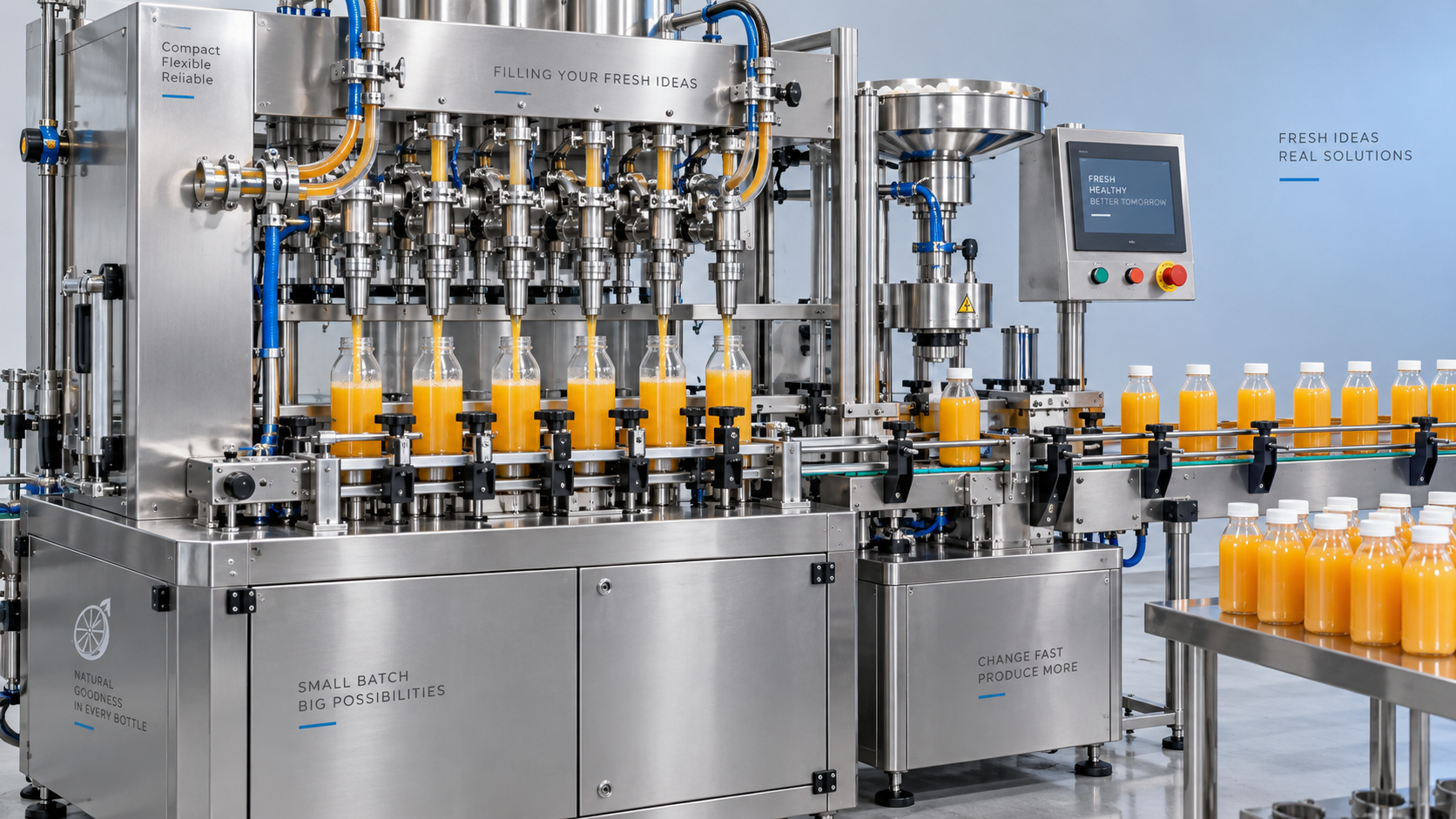
What Must Change When Switching a Filler From Juice to Nectar?
Can one filling machine handle both thin juice and thick nectar? Often, yes—but switching products takes more than changing a recipe on the control panel. Higher viscosity, pulp content and foaming behavior can affect fill accuracy, nozzle performance and production speed. The practical question is which differences can be managed through settings, and which exceed the machine’s physical limits.
A filler that runs clear apple juice reliably may struggle with a pulpy mango nectar even when both use the same bottle. Slow valve refill, unstable product supply and strings of liquid at nozzle closure can each cause different defects. Treating all three as a dosing problem usually leads to repeated adjustments without a stable result.
Start with the product—not its name
“Juice” and “nectar” are product categories, not reliable engineering specifications. Some juices contain substantial pulp; some nectars flow relatively easily. Composition and labeling definitions also vary by market. For equipment selection, the actual formulation and filling conditions matter more than the name on the label.
Compare both products at their intended filling temperatures. A viscosity value without a temperature and measurement method offers limited guidance, particularly for products whose apparent viscosity changes under shear. Ask whether the nectar thickens during holding, separates when stationary or changes texture after pumping.
The changeover specification should capture:
- Viscosity under relevant temperature and measurement conditions.
- Pulp concentration, largest expected particles and the presence of fibers.
- Density, entrained air and foaming behavior.
- Required fill quantity, bottle opening and acceptable headspace.
- Preservation method, filling temperature and cleaning requirements.
These details separate a straightforward recipe change from a retrofit. They also prevent a misleading trial: diluted nectar or a sample with less pulp than normal production may run well while concealing the actual restriction.
Check whether the filling principle still fits
A gravity filler may handle both products if the nectar flows readily through its existing passages. As flow resistance increases, however, filling takes longer and becomes more sensitive to tank level and valve opening time. Extending the fill duration can help, but it cannot remove a narrow passage or restore lost line capacity.
Pressure-assisted filling can provide more driving force, provided the tank, valves and controls are designed for it. Increasing pressure without reviewing the whole circuit risks stronger foaming, splashing or unstable shutoff. It is not a universal correction for thick product.
Piston and other positive-displacement systems can suit more viscous liquids, but suitability depends on the valve arrangement, particle clearance and product sensitivity. A piston chamber must refill completely between doses. If nectar cannot enter quickly enough, increasing machine speed may create short fills even though the nominal stroke remains unchanged.
Flowmeter-based filling also requires a product-specific check. Electromagnetic meters require suitable conductivity and properly filled measuring tubes. Entrained air can disturb measurement, while pulp compatibility depends on meter and valve construction. Mass-flow measurement can reduce reliance on density conversion, but it does not eliminate the effects of aeration or poor supply conditions.
The decision is therefore not simply “gravity versus piston.” It is whether the complete dosing system can deliver the required quantity, with the actual product, within the available cycle time.
Product supply often becomes the hidden bottleneck
Before replacing filling heads, examine how nectar reaches them. A feed pump that supplied thin juice comfortably may deliver less flow with a thicker product. Restrictive suction piping, tight bends and undersized strainers can leave the filler starved, especially as several heads open together.
Watch tank level and inlet pressure throughout a production cycle, not just while the machine is idle. If supply conditions fluctuate when filling begins, recalibrating individual heads will not solve the underlying problem. Review pump selection, pipe sizing, level-control response and the pressure drop through fittings.
Pulp introduces another issue: distribution. A batch may remain adequately mixed in the preparation tank but settle in a filler bowl, manifold or long connecting pipe. Gentle agitation or a suitable circulation arrangement may be necessary. Excessive agitation, meanwhile, can introduce air or damage texture. The objective is consistent product at every head—not maximum mixing speed.
Filtering equipment deserves particular attention. A filter used to protect a clear-juice line may remove intended nectar pulp or block rapidly. Any screen change should preserve necessary equipment protection while allowing the specified product structure to pass. Removing filtration indiscriminately is not a sound shortcut.
Valves and nozzles may need physical changes
Nectar needs adequate clearance throughout the product path, including valve seats, bends and internal transitions. The visible nozzle opening may look generous while a smaller passage upstream catches fibers. Request drawings or inspect the wetted components rather than relying only on the stated outlet diameter.
Shutoff behavior can also change. A clean-running juice nozzle may leave a hanging thread of nectar that lands on the bottle neck or conveyor. A different shutoff geometry, tip-mounted valve or controlled suck-back arrangement may help, depending on the machine. Excessive suck-back can draw air into the product path, so it needs testing rather than simply a larger setting.
Where equipment supports diving nozzles, the descent position and withdrawal profile may need adjustment to limit splashing and foam. A staged flow profile can provide a gentler finish. Neither feature should be assumed available on an existing rotary or fixed-nozzle filler.
Preserve hygienic design during modifications. An improvised adapter that improves flow but creates an inaccessible pocket can turn a production fix into a cleaning problem.
Re-establish accuracy at a realistic operating speed
The juice production rate should not automatically become the nectar target. Thicker product may need more time to enter the measuring chamber, pass through the nozzle and settle before bottle transfer. A stable lower rate is preferable to a nominally faster setting that generates rejects and repeated stops.
Start below the intended rate and increase gradually while checking every filling head. Separate startup behavior from steady operation, then repeat checks after a short stop. Product settling, temperature drift and pressure recovery can produce errors that a continuous trial misses.
Do not judge accuracy solely by the visible fill level. Bottle variation, foam and pulp distribution can make levels misleading. Use calibrated weighing equipment and, where converting mass to volume, a representative density measured under relevant conditions. Confirm the applicable net-content requirements for the destination market rather than adopting an arbitrary tolerance.
Record both average fill and head-to-head variation. A correct average can conceal one underfilling valve and another overfilling valve. Also inspect neck cleanliness: product on the sealing surface can matter as much as dosing accuracy.
Cleaning and thermal processing need separate approval
A juice cleaning recipe is not automatically adequate for nectar. Pulp and formulation ingredients can leave different deposits, particularly around valve seats, seals and poorly swept areas. Confirm that cleaning-in-place reaches the modified product path and that its operating conditions remain effective. Components outside the validated cleaning circuit may require disassembly.
The recipe should be supported by appropriate cleaning verification, not simply a visually clear final rinse. Where relevant, consider ingredient carryover and allergen controls as part of the changeover assessment.
Keep mechanical filling capability separate from food-safety validation. If the change also affects hot filling, pasteurization or aseptic operation, the process must be reviewed by qualified personnel. Viscosity, composition and particles can affect heat transfer and process requirements. A filler successfully dispensing nectar does not establish that the finished beverage is shelf-stable.
Higher filling temperatures may improve flow, but they cannot be selected merely to help the machine. Product quality, validated processing conditions, bottle heat resistance and closure performance must remain compatible.
Plan the changeover as a line trial
The filler is only one part of the conversion. Bottle rinsing conditions, cap application, conveyor timing and bottle drying should be checked under the new operating conditions. A slower filler changes accumulation patterns; sticky drips can affect bottle handling and downstream labeling or shrink packaging. Carton sealing may need no modification, but upstream interruptions still affect its supply.
For a supplier providing rinsers, fillers, cappers, conveyors, filtering and end-of-line equipment, the useful contribution is an integrated review rather than an isolated nozzle recommendation. OEM projects and tailored small-business lines benefit from the same discipline: clearly defined interfaces, documented change parts and realistic performance commitments for each product.
Before approving a retrofit or new machine, agree on a trial using representative nectar, actual bottles and intended closures. Include startup, steady running, planned stops, restart and cleaning. Define acceptance criteria for fill consistency, pulp distribution, neck cleanliness, sustainable output and changeover effort before testing begins.
One machine can serve both products when its dosing principle, product path and hygiene system cover their actual operating ranges. If the proposal depends only on longer filling times and higher pressure, ask what happens at the thickest expected batch and lowest permitted filling temperature. That is where a genuinely flexible filler separates itself from one that merely manages a demonstration.
Thank you very much for writing to us. Please leave your message and contact information, we will reply to you within 24 hours.