
Which Parts Must Change to Fill Chili Sauce in Bottles and Jars?
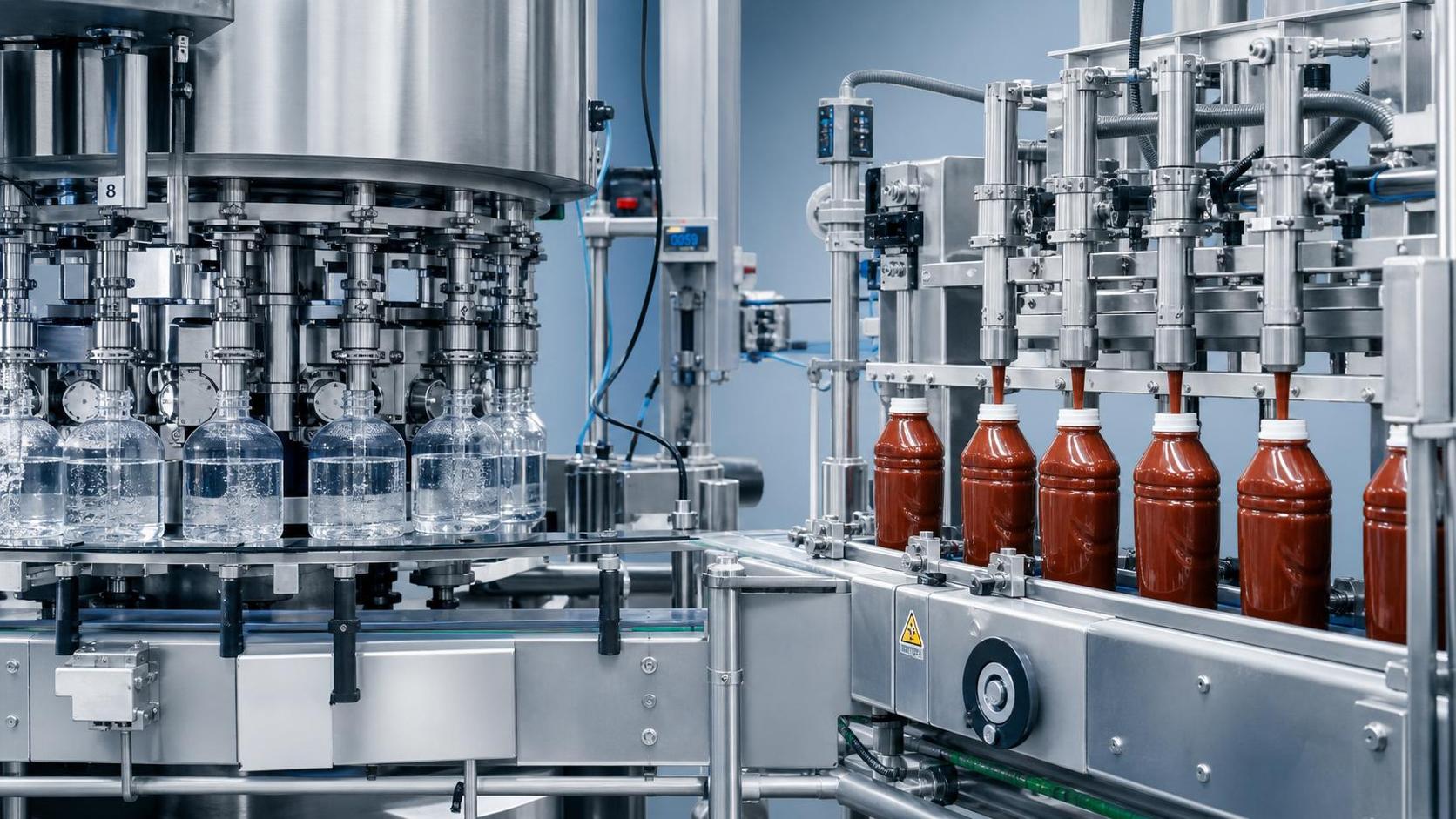
One filling machine can handle chili sauce in both bottles and jars when its product passages, filling range, and container handling system suit both formats. The parts most likely to change are filling nozzles, container guides, positioning parts, and closure tooling. Fill volume, nozzle height, conveyor settings, and dispensing speed often need adjustment. The pump or piston assembly can remain in place if it handles the sauce and both portion sizes correctly.
A wide jar opening generally gives the nozzle more clearance. A narrow bottle neck creates a tighter limit on nozzle diameter, alignment, and the passage available for chili pieces. This difference can determine whether a format change needs a few settings, a dedicated set of parts, or a different filling arrangement.
Which parts need replacement, and which only need adjustment?
The answer starts with the actual container drawings and sauce characteristics. Two containers with the same labeled capacity can require different handling parts because their heights, body profiles, neck openings, or base shapes differ.
A machine described as adjustable does not necessarily eliminate format parts. Adjustable rails can accommodate a different body width while a fixed star wheel still requires replacement.
The bottle neck sets the nozzle limit
Nozzle selection must satisfy both container clearance and sauce flow. The outside diameter must fit the bottle opening with room for normal positioning variation. The internal passage, including the shutoff valve, must pass the chili pieces, seeds, and fibers present in the recipe.
Choosing a smaller tip solely because it enters the bottle can create a restriction. Sauce may flow unevenly, particles may collect at the valve seat, and increased dispensing pressure may cause splashing. A large upstream hose does not solve a narrow passage inside the nozzle.
The largest relevant inclusion matters more than average particle size. Soft cooked chili fragments behave differently from firm seeds or long vegetable fibers. Fibers can bridge an opening that passes similarly sized rounded particles. Suitability therefore needs confirmation with the actual sauce, including representative larger pieces.
A single nozzle set can serve bottles and jars if it clears the narrower opening and fills both cleanly at the required output. Separate tips become useful when a larger jar nozzle allows faster dispensing or better cutoff. Changing only the outlet tip is insufficient if an upstream valve remains the limiting restriction.
Does an anti-drip nozzle stay the same?
That depends on how it closes. A positive shutoff design can control trailing sauce, but particles caught at the sealing surface can cause drips. A tip suitable for smooth chili sauce may perform poorly with coarse pieces.
Suck-back settings also need attention. Excessive withdrawal can pull air into the tip and produce an irregular start on the next fill. Persistent drips should prompt inspection for trapped material, wear, and unsuitable valve geometry before increasing suck-back. Sauce on a jar’s sealing surface can interfere with closure performance even when the measured fill is correct.
Container support changes with shape, not just diameter
Short, wide jars and tall bottles behave differently during stopping, indexing, and release. A tall bottle needs support that limits rocking near the filling position. A broad jar may require rail changes around shoulders, handles, or body features. Excessive rail pressure can distort flexible plastic containers and shift the opening away from the nozzle.
On a simple inline conveyor, changeover can involve rail width, stop position, sensor location, and nozzle spacing. On equipment using star wheels or timing screws, the pockets and screw profile commonly follow the container geometry. These are dedicated parts unless the system was specifically designed for adjustment.
Stable positioning becomes especially important when a nozzle enters a narrow neck. The clearance must accommodate variation in the container and its movement during indexing. Setting alignment with one empty sample does not establish reliable running conditions across a production batch.
For lightweight containers, base supports, neck guides, or stabilizing belts may also require adjustment. Any replacement contact parts should locate the container without scratching it, deforming it, or obstructing movement through the filling station.
Can the same pump or piston fill both sizes?
Often, yes. Changing from a bottle to a jar does not automatically require a new metering assembly. The deciding questions are whether the assembly handles the sauce and whether both portions fall within a useful dosing range.
A piston sized for a large jar can become difficult to control at a much smaller stroke. Mechanical resolution, valve timing, and product compressibility then have greater influence on the delivered amount. A smaller cylinder may be appropriate when the small portion cannot be reproduced reliably. Conversely, a large jar might require multiple strokes, which adds cycle time and can interrupt the flow.
For pump-based filling, usable speed range, displacement, and cutoff behavior determine whether one arrangement covers both portions. Increasing pump speed to maintain output can change pressure and affect particle integrity. A container fitting under the filling head establishes only physical compatibility.
Chili sauce also changes with temperature. A recipe that dispenses readily while warm can become harder to move after cooling. Trials should use the intended filling temperature and include realistic holding conditions. Otherwise, a successful short run can conceal restrictions that appear later.
Agitation deserves separate consideration when chili solids settle or oil separates. The same tank and agitator can remain if they maintain suitable distribution without damaging the inclusions. Changing the container does not itself justify replacing them, but a longer filling cycle can alter how long the sauce remains in the supply system.
Jar lids and bottle caps often require separate tooling
The filler may accommodate both formats while the capper becomes the main changeover constraint. Closure compatibility involves the complete path from sorting and delivery through placement and tightening.
A different screw-cap diameter can require another chuck, gripping insert, guide, chute, or sorting setup. The container-holding belts or clamps also need to resist tightening forces without allowing rotation or crushing the body. A torque setting suitable for one closure cannot simply be carried over to another.
A threaded bottle cap and a lug-style jar closure require different application conditions. Some jar processes also involve steam or vacuum-related closure equipment. In that situation, replacing a chuck alone will not make a bottle capper suitable for the jar package.
Closure verification should use the actual cap, container finish, liner, and filling temperature. Sauce contamination on the finish must be resolved at the filling stage; increasing cap application force does not correct a dirty sealing surface.
Which settings change even when the hardware stays?
Saved format recipes reduce repeated setup work, but they must include more than fill quantity. Nozzle height and movement, dispensing profile, container detection, and release timing all affect the result.
A bottle may benefit from a controlled start to prevent sauce striking the inner neck and splashing upward. A jar offers a wider target, but a faster stream can still deposit sauce on the rim or trap air in a thick product. The final dispensing speed influences cutoff and the amount left hanging at the tip.
If the nozzle descends into the container, its withdrawal needs to match the rising product level. Excessive immersion leaves sauce on the outside of the tip. Withdrawal that is too fast increases the fall distance and can cause splashing. The suitable motion differs with container geometry and sauce behavior.
Fill volume and headspace also need separate settings. Bottles and jars with the same nominal capacity can have different usable volumes below the closure. Where sauce is filled warm, cooling behavior and the closure process must be considered when establishing the target level.
What proves that one machine can run both formats?
A useful trial combines the actual containers, closures, and representative sauce. Testing empty containers confirms positioning and clearance, but it does not establish particle passage, fill consistency, or clean cutoff.
The two formats should be assessed under their own intended conditions. The narrower bottle tests alignment and nozzle clearance. The larger portion tests delivery capacity and cycle time. A small portion reveals whether the metering assembly remains repeatable near the lower end of its range.
The trial should establish:
- Reliable positioning: containers enter, stop, fill, and leave without tipping, jamming, or contacting the nozzle.
- Delivered quantity remains consistent through repeated cycles. Where mass measurements are used to assess a volume target, sauce density and entrained air need consideration.
- Chili pieces pass without accumulating at restrictions, and the filled product retains a representative distribution of solids.
- The rim or neck finish stays clean enough for the intended closure process.
- A completed format change returns the machine to acceptable performance after the documented setup and startup procedure.
The changeover record should identify each replacement part, its fitting position, and the associated settings. Quick-release product-contact connections can simplify removal, but seals still need correct seating and inspection. Newly installed nozzles and valves must follow the applicable cleaning procedure before production resumes.
A clear compatibility statement names the bottle and jar formats, sauce characteristics, fill quantities, operating temperature, required parts, and demonstrated running conditions. That information makes “one machine for both” a usable technical specification and reveals exactly what must change between runs.
Thank you very much for writing to us. Please leave your message and contact information, we will reply to you within 24 hours.