
Complete Filling Line Costs in 2026: What Small Factories Should Expect
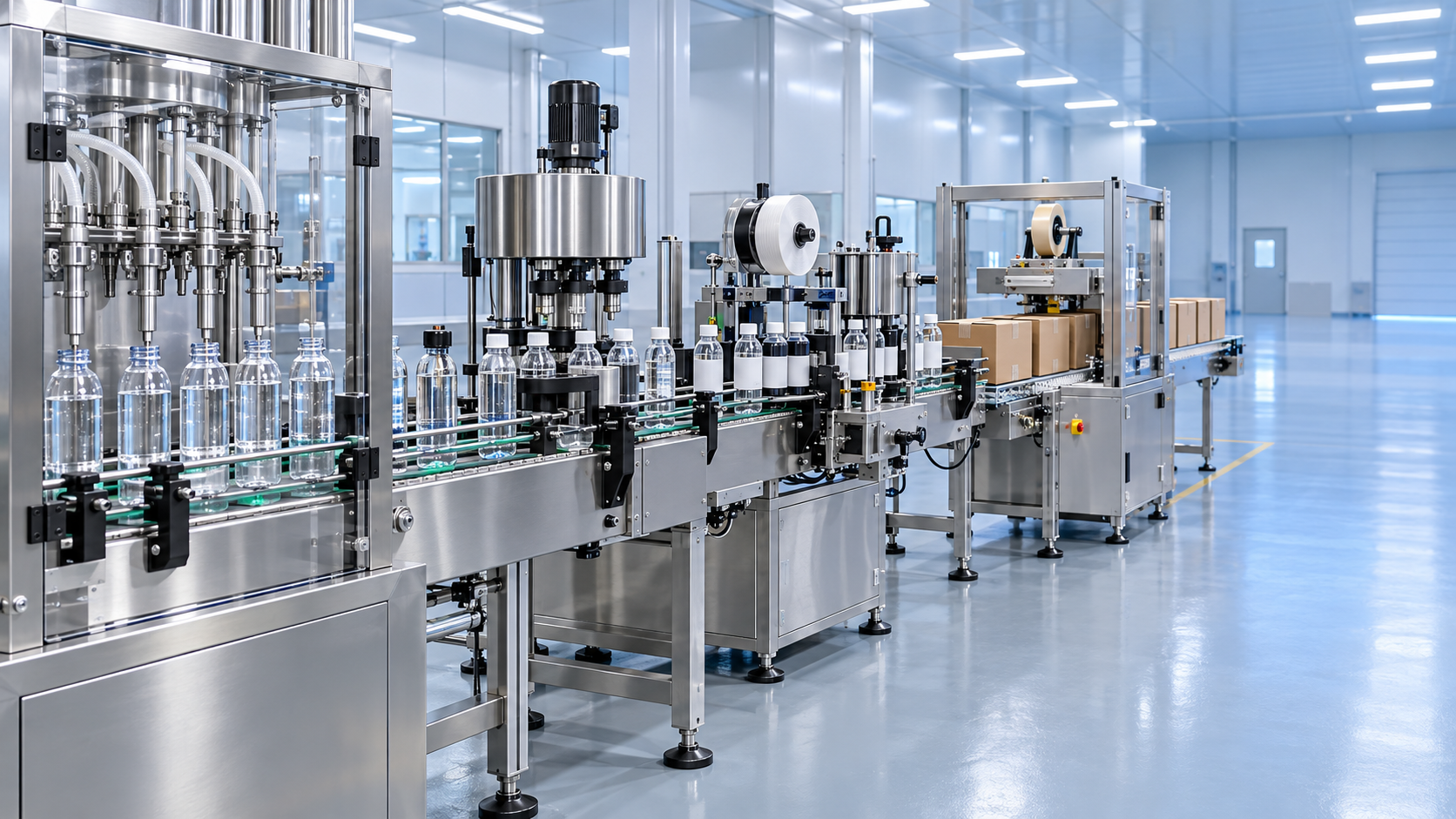
The practical answer to “How much does a complete filling line cost for a small factory?” is that the price is driven less by the word “complete” than by what the line must actually do. A compact line filling one stable liquid into one bottle type can be relatively straightforward. A line handling several bottle sizes, viscous products, hygiene-sensitive production, difficult caps, labeling, shrink packing, and carton sealing is a different investment.
For a small operation, the most useful way to budget is not to ask for the price of a generic filling line. Start with the finished package and work backward: product condition, bottle or container, fill volume, cap, output target, cleaning method, label or sleeve, and final shipping carton. Each requirement changes the equipment needed and the level of automation that makes sense.
A realistic quotation should separate the core filling equipment from the supporting machines, installation-related work, format parts, and future expansion options. That makes it easier to see where money is being spent and where a simpler design may be appropriate.
What Is Included in a “Complete” Filling Line?
In daily conversation, a complete filling line often means a bottle enters empty and leaves ready for storage or shipment. In practice, the definition varies. Some factories need only rinsing, filling, capping, and conveying. Others also need product filtration, drying, shrink sealing, labeling, coding, carton packing, and carton sealing.
The equipment sequence usually follows the product and packaging process:
- Product preparation or filtration, where required
- Bottle washing or rinsing
- Automatic or semi-automatic filling
- Capping, corking, or sealing
- Container drying or shrink treatment when the package requires it
- Conveying between machines
- Labeling, coding, or inspection equipment where needed
- Carton packing and carton sealing for outbound handling
Not every small factory needs every station. A frequent budgeting mistake is to buy a line designed around a broad equipment list rather than the actual production flow. For example, a product with clean incoming bottles and a simple screw cap may not need the same preparation and closure system as a pharmaceutical liquid or a product sold in shrink-wrapped multipacks.
On the other hand, leaving out a necessary supporting machine can create a line that technically fills bottles but cannot run smoothly. A filler that waits for caps, cartons, or operators to move bottles manually will not achieve its intended output. The cost of a complete line should therefore be judged by usable production capacity, not by the price of the filler alone.
The Four Decisions That Change the Budget Most
1. The Product Being Filled
Water-like liquids, oils, syrups, creams, detergents, gels, powders, and corrosive chemicals do not behave the same way in a filling machine. Product viscosity affects pump choice, filling principle, pipe diameter, cleaning requirements, and the speed at which a stable fill can be achieved.
A thin, free-flowing beverage may suit one filling approach, while a thick sauce or lotion may require a different system to avoid inconsistent fill levels, dripping, air pockets, or product damage. Foaming products can need slower filling control or nozzle arrangements that reduce splashing. Products containing particles may require special attention to valves and product paths. Chemical products may require material choices that resist the formulation.
Small factories sometimes compare filling machines only by the number of nozzles. That is incomplete. A multi-nozzle machine is not automatically the better value if it is poorly matched to the product. Stable filling accuracy, clean changeovers, and easy cleaning can matter more than nominal speed.
2. The Container and Closure
The bottle is not merely a container; it is a mechanical part of the production line. Its diameter, height, base stability, neck finish, material, and shape affect how it moves on conveyors and how reliably it is filled and capped.
Lightweight bottles can tip or deform. Narrow-neck bottles require suitable filling nozzles. Unusual bottle shapes may need guides, star wheels, or dedicated change parts. Caps also vary widely: screw caps, trigger sprayers, pumps, flip-top caps, aluminum caps, corks, and tamper-evident closures each require different handling and tightening methods.
A line built for one bottle and one cap format is usually easier to configure and operate than a line expected to manage many formats. If several formats are essential, include changeover requirements in the initial discussion. Otherwise, the factory may discover later that each “small” package variation needs additional tooling, adjustment time, or manual intervention.
3. Automation Level
Automation should match production rhythm, labor availability, and product range. It should not be selected simply because fully automatic equipment sounds more advanced.
For small factories, a compact automatic line is often a sensible middle ground when demand is consistent enough to justify continuous conveying, automatic filling, and capping. It can reduce repetitive manual work without forcing the factory to purchase packaging equipment that will remain underused.
However, manual or semi-automatic equipment may be the better commercial choice when the business changes products frequently, launches seasonal varieties, or has not yet settled on its final bottle design. In that situation, flexibility may be worth more than a high nominal output.
4. Production Rate and Run Length
Required output should be based on actual production planning, not an ambitious future target. Consider how many bottles must be packed during a normal production shift, how often the product changes, how long cleaning takes, and whether the line will run continuously or in batches.
A line is only as fast as its slowest practical station. If filling is fast but capping is slow, bottles accumulate. If cartons are packed manually at a slower rate than the conveyor delivers finished bottles, operators may need to stop the line. A balanced system uses compatible speeds across rinsing, filling, capping, conveying, and end-of-line packing.
It is often better to specify a line that runs reliably at the planned production rate than to buy a much faster machine that requires frequent stops, extra labor, or difficult adjustments. Capacity reserve is useful, but extreme oversizing can make a small operation harder to operate and maintain.
Costs That Are Easy to Miss During Early Planning
The visible machines are only part of the investment. A useful equipment proposal should identify the practical items required to put the line into operation.
- Format parts and change parts: Guides, holders, star wheels, cap tooling, and other components may be needed for each bottle or cap format.
- Conveyors and accumulation: Machines need enough connection and buffer space to keep products moving between stations without constant intervention.
- Product transfer: Tanks, pumps, hoses, filters, and suitable connections can be essential, particularly for viscous, sensitive, or chemical products.
- Utilities: Electrical supply, compressed air, water, drainage, ventilation, and cleaning arrangements must suit the selected equipment.
- Installation layout: Machine footprints are only one part of the space requirement. Operators need access for loading, adjustment, cleaning, maintenance, and material movement.
- Commissioning and training: A line needs proper setup around the actual product, bottle, cap, and operating procedure.
- Spare and wear parts: Some components will need routine replacement. Planning for them helps avoid unnecessary downtime.
Freight, site preparation, packaging material trials, and local installation work also affect the total project budget. These are not reasons to avoid automation; they are reasons to compare proposals on the same scope. A lower initial machine quote can become less attractive when essential supporting items are excluded.
Where Small Factories Can Simplify Without Creating a Bottleneck
There are sensible ways to control the cost of a filling line. The first is to limit initial package formats. Launching with one or two well-defined bottles and closures is usually easier than demanding broad compatibility from day one. Expansion can be planned through modular conveyors, adjustable guides, or a layout with room for added stations.
The second is to separate essential process equipment from optional presentation equipment. Filling, reliable closure, and hygienic product handling are fundamental. Decorative secondary packaging, advanced inspection, or highly automated case packing may be valuable later, but they should be evaluated against actual sales volume and labor needs.
The third is to avoid false economy around the capper and conveyor system. Filling equipment receives most attention because it handles the product, yet poor capping causes leaks, loose closures, damaged caps, and rejected packages. Inadequate conveying leads to bottle instability and repeated line stops. A balanced filling and capping system is usually more valuable than a high-spec filler connected to improvised downstream handling.
For food, daily chemical, pharmaceutical, and chemical applications, the level of cleaning, material compatibility, and process control should reflect the product’s real handling needs. Buying a system with unnecessary complexity raises cost and operating burden. Buying equipment that cannot be properly cleaned or safely matched to the product creates a more serious problem.
How to Request a Comparable Filling Line Quote
A productive quotation request gives the equipment supplier enough detail to design a usable solution. Sending only a target number of bottles per hour often produces a generic response that is difficult to compare.
Prepare the following information before discussing a line:
- Product name, viscosity, temperature during filling, foaming behavior, and whether it contains particles or requires filtration.
- Container drawings or samples, including bottle dimensions, neck details, cap type, fill volume, and material.
- Expected production schedule: batch size, number of product changes, planned output, and likely future formats.
- Required process steps, such as rinsing, filling, capping, shrink treatment, drying, labeling, carton sealing, or filtration.
- Available workshop space, preferred line direction, power and air conditions, drainage, and access routes for equipment delivery.
- Any hygiene, traceability, packaging, or handling requirements that affect machine design.
Then ask the supplier to define the line boundary clearly. Does the proposal include bottle rinsing? Are conveyors included between all machines? Which bottle and cap formats are covered? Is the equipment designed around your product characteristics? What is supplied for cleaning, adjustment, and normal operation?
This approach is particularly useful for tailored small-business solutions. A supplier with filling machines, bottle washing and rinsing machines, capping or corking equipment, shrink and drying machines, conveyors, carton sealing machines, and filtration equipment can configure the line around the actual process instead of treating every project as a standard filler sale. OEM requirements may also affect the final scope when the product, package, or workflow needs a non-standard arrangement.
Common Purchasing Mistakes
Choosing only by listed speed. Published output does not show how a machine will perform with your bottle, liquid, cap, and operator workflow. Ask how the equipment handles your packaging combination.
Assuming every automatic line is equally easy to change over. Frequent changes between bottle sizes, caps, and products can consume more time than expected. Changeover design matters when product variety is high.
Ignoring the downstream process. Filled and capped bottles still need to be handled, labeled, packed, and moved. End-of-line congestion can erase the benefit of faster filling.
Designing for an uncertain future instead of a real first stage. Build enough flexibility for credible growth, but avoid paying for every possible bottle, closure, and packaging option before demand justifies it.
Comparing quotes without a scope checklist. Two proposals can appear similar while including very different levels of conveying, tooling, controls, product contact parts, or commissioning support.
Start With the Production Flow, Not a Single Machine Price
A complete filling line is an operating system, not a collection of isolated machines. The most appropriate investment is the one that fills the required product accurately, applies the closure reliably, moves containers without disruption, fits the available space, and can be operated by the factory team every day.
Before asking for a final price, define the product, package, output target, changeover frequency, and required finishing steps. With those details in place, a line can be configured from the right combination of rinsing, filling, capping, conveying, drying or shrinking, filtration, and carton sealing equipment. The resulting budget will be more meaningful because it reflects the production line the factory can actually use.
Thank you very much for writing to us. Please leave your message and contact information, we will reply to you within 24 hours.