Liquid Filling Industry at a Crossroads: Why One-Stop, Customized Solutions Are Replacing Low-Cost Single Machines
Time : Oct 31, 2026
The liquid filling and water treatment equipment industry is facing a structural shift. After years of low-price competition that has compressed profit margins across the board, manufacturers and buyers alike are realizing that the old model — selling standalone machines at the lowest possible price — no longer meets the demands of modern production. Shandong Tuodao Intelligent Equipment Co., Ltd. (Tuodao), a Qingzhou-based manufacturer with nearly 20 years of experience, argues that the real differentiator in this industry is no longer price, but integration: the ability to deliver complete, customized, automated production lines.
The problem: homogenization and price wars
Product homogenization is widespread across the filling and water treatment equipment industry. Most manufacturers produce equipment with limited functionality and little innovation in core filling technologies. Because competition has centered on low prices rather than technical value, the overall profit margin of the industry has been squeezed. Many manufacturers simply cannot invest in R&D, which in turn makes it difficult for them to adapt to the production needs of multiple types of liquids.
The result is a market crowded with generic machines that struggle to meet the differentiated needs of diverse industries such as food, daily chemicals, chemicals, and drinking water.
The hidden cost: buying single machines means coordinating multiple suppliers
One of the most overlooked inefficiencies in this industry is that most manufacturers can only supply standalone equipment. They cannot simultaneously provide water treatment equipment and complete filling production lines. As a result, customers must contact different suppliers for rinsing, filling, sealing, and water purification — a process that creates high communication and coordination costs and prolongs the overall production cycle.
Small manufacturers, lacking sufficient technical reserves, can only produce general-purpose models. They cannot customize solutions for special materials, which is exactly where the needs of edible oil, beverage, condiment, and chemical producers become impossible to serve with off-the-shelf products.
Supply chain and after-sales: where reliability breaks down
The prices of upstream raw materials such as stainless steel and sealing components fluctuate frequently. Manufacturers with weak supply chain management face unstable equipment delivery cycles, which directly disrupts their customers' production planning. Meanwhile, small manufacturers often lack a complete after-sales system. When equipment malfunctions, response is slow, and downtime for repairs directly delays production — a costly failure for any production line.
For production users, these are not abstract concerns. Foaming materials interfere with metering; a single machine cannot handle multiple liquid types; metering adjustment is cumbersome and accuracy unstable; bottle-type compatibility is narrow; and ordinary equipment lacks the protective structures needed to prevent bottle jams and breakage. All of these translate into lost material, lost packaging, and lost time.
The shift: from single machines to one-stop, customized solutions
Against this backdrop, the industry's competitive logic is changing. Buyers are increasingly evaluating suppliers not on unit price alone, but on whether they can deliver an integrated, automated production line tailored to a specific material, bottle type, and production capacity.
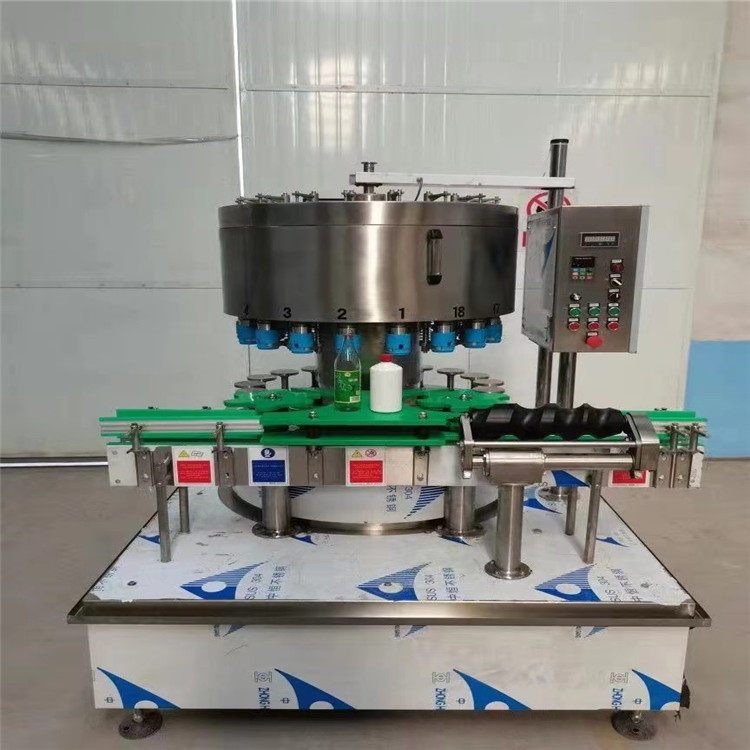
This is the model Tuodao has built around. By combining a complete range of individual machines — filling, bottle brushing, bottle rinsing, sealing, corking, heat shrinking, drying, conveying, carton sealing, and filtering — with water treatment equipment, the company can form fully automated production lines for materials ranging from edible oils, alcoholic beverages, and condiments to glass cleaner and liquid fertilizers. Its water treatment offering covers reverse osmosis pure water, ultrafiltration, fully automatic soft water, and high-purity water equipment, paired with large-barrel and small-bottle filling lines for drinking water production, factory water supply, boiler water supply, and aquaculture and planting applications.
Why customization and service will define the next decade
Two capabilities will separate leaders from laggards in the coming years. The first is customization. Tuodao's technical team, drawing on practical experience filling edible oils, beverages, condiments, and automotive chemical liquids, designs exclusive production lines based on each customer's factory space, production capacity, and material characteristics — because general equipment cannot fit the actual production conditions of a real factory.
The second is service. A comprehensive after-sales system that responds promptly to equipment issues, combined with operation and maintenance guidance, reduces equipment downtime and extends equipment lifespan. In an industry where production line stoppages are expensive, long-term service is becoming a competitive advantage in its own right.
The bottom line
The era of competing on low price alone is ending. As the industry moves toward integration, automation, and customization, the manufacturers that win will be those that can supply a complete, reliable, service-backed solution — not just the cheapest single machine. For buyers, the question is no longer "who sells the cheapest filler," but "who can build and maintain the production line my business actually needs."
Previous page:Already the first
Next page:Already the last
Related Posts
Online Message
Shandong Tuodao Intelligent Equipment Co., Ltd.
Thank you very much for writing to us. Please leave your message and contact information, we will reply to you within 24 hours.